Importing gas, exporting services
Can T&T become a services hub for Venezuelan gas?
19th June 2026
The news that Shell has signed a non-associated gas license with the Government of Venezuela to develop the Loran field in the Plataforma Deltana region is significant for the energy sector in Trinidad & Tobago.
Much of the discussion has been about the fact that natural gas produced from the Loran field will be exported across the maritime boundary to the Manatee field infrastructure already under construction and then will flow to the Atlantic LNG facility in Point Fortin for sale into international markets. From the news made public so far, it is not clear if any of the gas will be contracted to the domestic petrochemical plants in Trinidad, though even if all of the Loran gas is earmarked for LNG that might free up other domestic gas for petrochemicals. Under phase one of the project one hundred percent of the gas produced at Loran will be exported to Trinidad, with this first phase covering the first 1.7 trillion cubic feet (tcf) out of a total reserve base of around 7.3 tcf.
While the Trinidad discussion has focused on the gas imports, it would also be good to hear some discussion about how the Loran field will be developed and the opportunities that this might create for Trinidad to act as a logistical hub to service the field, during both the development phase and ongoing operations. In other words, service exports to Venezuela.
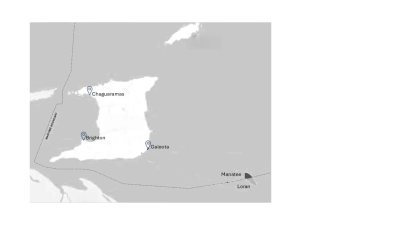
The Manatee/Loran field is located some 100 km off the southeast coast of Trinidad and is significantly closer to the major offshore logistical support ports in Trinidad than facilities in Venezuela. The nearest Venezuelan port facility to the Loran field is at Guiria, but this is not a well-developed port facility with the necessary yards, warehousing and other support facilities needed to develop a major project like Loran. The nearest major Venezuelan port facility would be Puerto Sucre on the Caribbean Sea coast, around 350 kms from Loran.
On the Trinidad side there are well developed and serviced deepwater logistical port facilities at Brighton and in Chaguaramas, as well as the Galeota port which is closest to the Loran field and well suited for ongoing operations and maintenance support. Helicopter transfers to and from the drilling rigs developing Loran/ Manatee, and access to the Manatee platform once installed, will be much closer from the Piarco or Campden heliports in Trinidad than anywhere in Venezuela.
There are many service companies based in Trinidad with a long experience of working with Shell on offshore gas fields and meeting the company’s rigorous safety and environmental standards. This includes both local Trinidadian companies and major international service companies based in Trinidad.
From a practical point of view, Trinidad is therefore well positioned to act as the hub for the Loran field development. However, the government of Venezuela and Shell will rightly also want to find ways to maximise Venezuelan local content for any development within Venezuela. This means that, when possible, they will try to use Venezuela companies and Venezuelan workers for the Loran development. Venezuela has a long and proud history in the petroleum sector and its private sector companies rightly will want to be heavily involved in the project.
The sanctions (and geopolitical) environment also means that there will be a demand to use United States headquartered companies for the development, including using U.S. financing to support companies supplying goods and services.
While there is no detailed information yet in the public domain, I suspect that the gas on the Loran side of the maritime boundary will be developed through sub-sea infrastructure and tied back to the Manatee platform, currently under construction at the TOFCO yard in La Brea, Trinidad and the McDermott yard in Altamira, Mexico. The original published plans for the Manatee platform were for an 8 well slot platform, but this has now been increased to 12 well slots, which I suspect is to accommodate additional wells from Loran across the maritime boundary.
This means that when it comes to the Loran field, there will probably be lower volumes of offshore construction work than for Manatee.
The Manatee jacket and piles being constructed at TOFCO are reported to be the biggest project constructed at the yard. Jacket is the industry jargon for the legs of the platform that will rest on the sea floor supporting the usually unmanned topside where all the production equipment and controls will be located, while the piles secure the jacket in place on the sea floor. The water depths at which the platform is going to be installed can give a sense of the scale of this structure: it is about a quarter taller than the Waterfront Towers in Port of Spain.
The fact that this structure is being constructed in Trinidad has a big positive effect on Trinidad content in the Manatee project, as the TOFCO yard not only employs hundreds of workers directly it also creates business opportunities for a myriad of other suppliers in Trinidad. For the development of the Loran side of the field the volume of fabrication work will probably be less for the same volumes of gas and will likely for be subsea infrastructure.
Nevertheless, when the Loran wells are drilled and the infrastructure is installed there will still be significant opportunities for Trinidad content in the project, including drilling support services, logistics, marine vessel provision, crew transfers, inspections and rig and support vessel provisioning. To maximise the value that can be gained for Trinidad, there needs to be early and deep engagement with not just Shell but also stakeholders in Venezuela, including the relevant Chambers and associations and private sector companies. Given the sanctions regime, it will also be important to discuss opportunities and possible constraints with US representatives and stakeholders.
While the focus has been on securing the gas imports to Trinidad, there needs to be an equal focus on accessing the service export potential that the Loran and other gas developments in Venezuelan waters could represent. Trinidadian private-sector trade associations, especially the Energy Chamber, have a big role to play in this engagement and there have been positive past engagements with the Venezuelan private sector, including at the 2025 Trinidad & Tobago Energy Conference. But this could do with a national effort and strong facilitation from the government of Trinidad & Tobago.
The government of Trinidad & Tobago should also take a detailed look at the regulatory barriers that could limit the use of Trinidad as a hub for the developments, in particular the customs regulations and duties involved in moving equipment between Trinidad and Venezuela. The implementation of the ATA Carnet system, a sort of passport for equipment, would be especially useful as it would allow equipment being used on the Loran field to be brought into and out of Trinidad for storage or basic maintenance without any duties.
While there is a huge potential for Trinidad to be a hub for processing Venezuela gas, we should also be focussing on the development of Trinidad as an energy services hub for offshore Venezuelan oil and gas developments. This is a national effort that needs to be prioritised now.