Perilous times for Point lisas
Methanex indefinitely suspends operations in T&T
29th June 2026
The news that Methanex have decided to close their Titan methanol plant in Point Lisas should not come as a surprise.
The company clearly signalled this risk earlier this year, when they advised their shareholders that there was a risk that they would not be “able to secure additional natural gas on commercially acceptable terms … to enable us to operate at capacity or at all”. Nevertheless, when the actual news breaks of another major multinational company ceasing petrochemical production, the risk on paper suddenly becomes real, especially for the hundreds of employees and thousands of contractor workers who now face an uncertain future.
Coming on the top of the closure of the Nutrien ammonia plants seven months ago, this is a major blow to Trinidad’s petrochemical industry. Methanex’s bigger Atlas methanol plant has been mothballed since September 2024, and it is now joined by Titan. Nutrien is looking for a buyer for its Trinidad assets.
Facing low volumes of gas supply from the upstream companies through the rest of 2026 and 2027, the National Gas Company (NGC) has taken a decision to focus on the short-term revenue that it can secure from LNG sales to international markets. It has only offered short terms contracts to the Point Lisas plants, at higher prices. Three of the major customers (Proman, PLNL, and Yara/Tringen) have signed these contracts for 2026 and have continued to operate for now, while two (Nutrien and Methanex) have decided to cease operations. Every company will have different business drivers, including different options of where to deploy their capital around the world. For Methanex and Nutrien, investing in Trinidad and continuing to operate under the gas contracts on offer, clearly did not make economic sense.
The danger of the current strategy for Trinidad & Tobago is that if and when the increased gas production begins to flow in 2028, there will no longer be the portfolio of downstream petrochemical plants available to take the gas. Plants cannot be simply brought back into production with the flick of a switch. Major investments will be needed in maintenance and upgrades, and the longer plants are left idle, the bigger the investment needed. Will multinational companies be willing to take that risk and invest in Trinidad?
Putting all of our eggs in the LNG basket has clear risks: there is a glut of LNG set to come onto international markets over the next few years with major project start-ups especially in the USA. Most analysts are predicting LNG prices trending downwards over the next few years. It is always good to have a balance in the portfolio and having methanol and ammonia (and its derivatives) gives a balance to the routes to monetise our gas resources.
The Point Lisas industrial estate has created a lot of value for Trinidad over the decades, with a large number of well-paying jobs and opportunities for many contractors and other service companies in and around the Point Lisas and Couva areas. The estate drives economic activity as far away as Chaguanas and San Fernando, with maintenance facilities, warehouses and suppliers to the estate. Less economic activity on the estate directly impacts the retail outlets, food vendors and other small businesses in the area.
The Point Lisas contractor base is already under severe strain. There has been a significant erosion in the availability of skill labour over the past few years, with skilled workers exiting the industry or emigrating to Guyana, Suriname or the USA. Contractor companies themselves have faced significant challenges, and the local energy services and contractor sector has been weakened. This means that if companies are considering whether to restart their plants in the future, they will face higher costs and increased safety risks, all of which will factor into their decision making.
This feels like a perilous time for the Point Lisas industrial estate, for so long the jewel in the crown of Trinidad’s energy sector. The anticipated increases in gas supply in a few years’ time offer a glimmer of hope for the sector, but the risks are very evident.
Venezuelan gas offers a possible lifeline, but will that gas be available to the downstream plants at competitive prices with the secure longer-term contracts that they will need to justify investment in restarting mothballed facilities? That remains an open question.
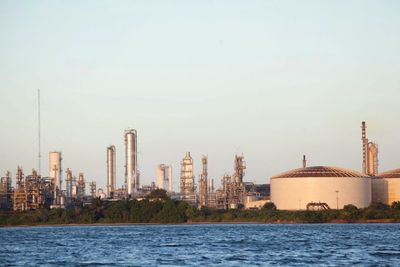
Point Lisas from the Gulf of Paria. Photo courtesy Energy Chamber of T&T